
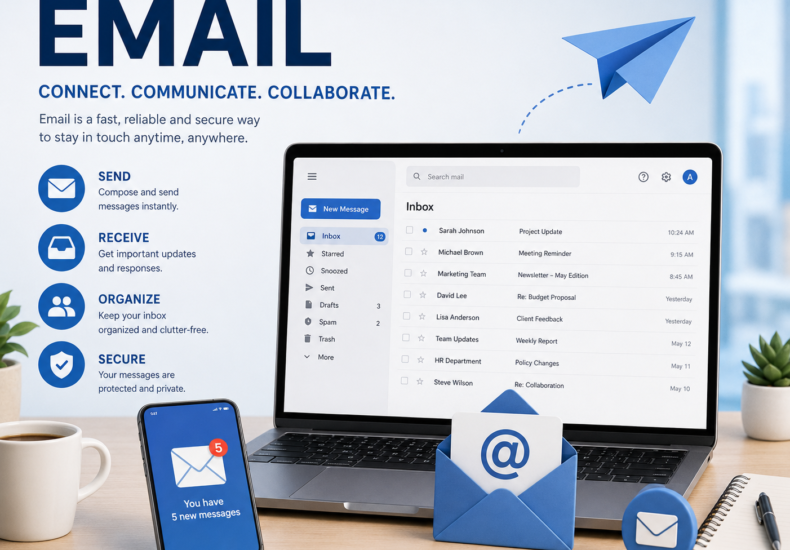
What is Email? Know its Advantages and Disadvantages
Email, which is short for electronic messages, has become among the most commonly used ways of communicating in our modern times. From teachers and students to government agencies and businesses email has become an integral element of our lives. It lets people communicate messages, documents, images, as well as other types of information immediately across the world. Despite the rapid growth of instant messaging applications and social media, email has managed to be relevant because of its formal nature and dependability. But, as with all technologies email is not without its advantages and drawbacks. Understanding these will help us use it better.
Advantages of Email
1. Fast and Instant Communication
One of the greatest benefits of email is the speed. A message can reach its recipient in just a few minutes, regardless of where they live around the globe. This makes email extremely beneficial to communicate urgently, particularly in academic and professional settings where prompt responses are typically needed.
2. Low Cost
Email is a cost-effective way to communicate. When you’ve got internet access sending emails is almost nothing. There aren’t any printing or postage costs associated with it. This makes email a great choice for companies that want to regularly communicate with clients employees, customers, or partners.
3. Easy to Use
The email services are easy and easy to use. Anyone with a basic computer or smartphone skills can learn how ways to exchange and send email. Many email platforms have easy options for writing and replying to emails, forwarding them, and tying files together which makes the process easy even for novices.
4. Ability to Send Attachments
Emails let users include images, documents video pdfs, spreadsheets and many other information. This feature is particularly useful to send official documents such as resumes, assignments reports, presentations, and other documents. Multiple documents can be shared at the same time which saves both time and energy.
5. Record Keeping and Documentation
Emails can be archived or searched for and archived quickly. This makes them an ideal tool to keep documents. For professional purposes, they usually serve as proof in writing of communications, decisions or agreements. Users may refer to emails from the past whenever they need.
6. Accessible Anytime, Anywhere
Emails can be read from tablets, computers or even smartphones. So long as there’s Internet connectivity, the users are able to access their emails at any time and from any place. This makes email suitable for remote work as well as long-distance communications.
7. Supports Formal Communication
It is widely recognized as a formal way for communicating. It is often used to send formal notices, applications for jobs and business proposals, as well as support for customers and academic correspondence. The formal format of email can help keep the professionalism.
8. Environment Friendly
Email can reduce the requirement for paper. Through replacing the use of printed letters, forms and other documents, it helps conserve trees and decreases the amount of waste. This makes it an green option than traditional mail.
Disadvantages of Email
1. Requires Internet and Devices
To be able to use email, one requires an access point like either a smartphone or computer as well as a reliable internet connection. In areas where connectivity is poor or in areas where people do not have a digital literacy the internet isn’t always accessible.
2. Risk of Spam and Junk Mail
One of the main issues with email is the spam. Many users receive spammy advertising, promotional messages and fake messages. Spam emails clog the inbox and often include harmful links or malware.
3. Security and Privacy Issues
Emails are at risk of hacking, phishing and data breaches. The sensitive information sent via emails can be accessed in the event that security precautions are not followed. False emails that appear authentic can lure users to divulge financial or personal information.
4. Lack of Personal Touch
In comparison to face-to-face conversations or telephone calls, emails can appear unpersonal. The tone, emotion and body language can be not present, leading to confusion. An unprofessional or inadequately written email could sound rude, even though that’s not the intent.
5. Information Overload
Many people receive dozens or sometimes hundreds of messages every day. Important messages are often lost in the clutter of less important messages. The task of managing a busy inbox can be a stressful and tiring experience which can result in a decrease in productivity rather than increasing it.
6. Misinterpretation of Messages
Because email communications are text-based it is possible for the message to be misinterpreted. Sarcasm, jokes, or emotional expressions could not be properly understood by the recipient and cause confusion or even conflict.
7. Not Ideal for Urgent Matters
While emails are quick but there is no guarantee that the receiver will get the email immediately. In urgent circumstances, phone calls or instant messaging might be more effective.
8. Dependence on Technology
The email system can be affected by technical issues like delay in delivery, server failure or account problems. If the system is not functioning communications can be interrupted particularly for organizations which rely on email.
Conclusion
Email has revolutionized the way people communicate, making it more efficient, less expensive and more efficient. The ability to communicate immediately, instantly share files, and manage records makes it an indispensable tool for business, education as well as everyday life. In the same way issues like security threats, spam and the lack of a personal connectivity cannot be ignored.
The key is to use email in a responsible manner. By following the right practices such as creating clear messages, avoiding dangerous links, and organising email inboxes efficiently, users can take advantage of the benefits of email, while minimizing its drawbacks. In the time that is dominated by instant messages and social networks, email still manages to play a vital and vital position in modern-day communications.
You may also like


Leave a Reply