
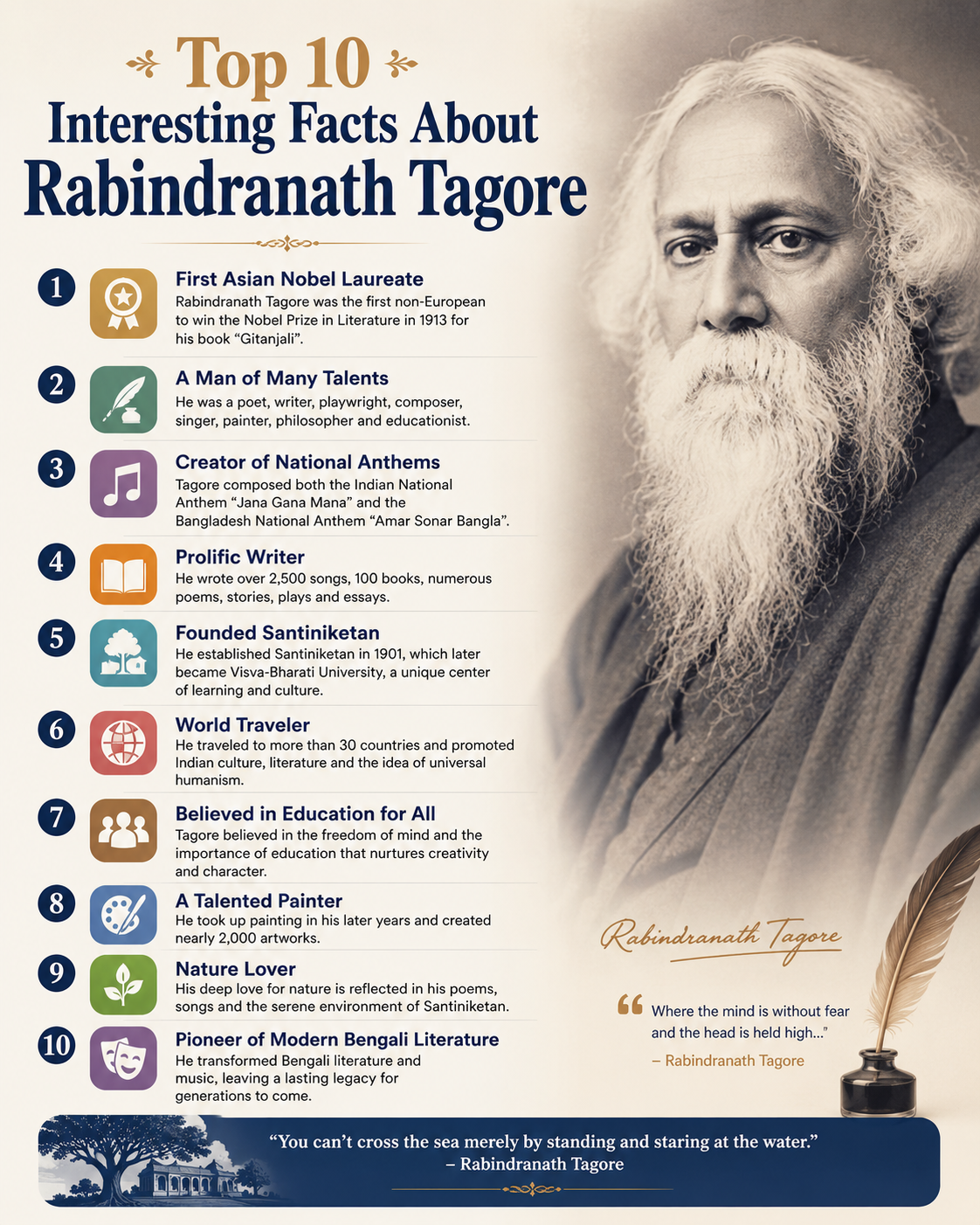
Top 10 Interestinag Facts About Rabindranath Tagore
Rabindranath Tagore wasn’t just poet or writer, he was an idea of thought. In a time where there was a divide between the human race, empires and race, as well as rigid customs, Tagore spoke the language of freedom, humanity and truth. His words were kind however their impact was profound. He challenged authority without anger and praised life with no arrogance.
Tagore thought that the pursuit of education must spark interest, that art must help heal your soul and liberation must begin with the mind. He lived through an era of turmoil under colonial rule, but his ideas were global as well as timeless and personal. These ten facts show the reason Rabindranath Tagore is among the top thought leaders India can ever produce.
10 Interesting Facts About Rabindranath Tagore
1. Rabindranath Tagore Was Asia’s First Nobel Laureate
The year 1913 was the year Rabindranath Tagore made history as the first Asian to be awarded the Nobel Prize in Literature.
He was awarded the prize to commemorate Gitanjali Gitanjali, an album of profoundly spiritual poems which explored the connection between human souls as well as the Divine. The thing that captivated everyone wasn’t only its poetry but rather its ease of use and its universality. His work transcended the boundaries of culture but without losing the Indian soul.
2. He Wrote the National Anthems of Two Countries
Rabindranath Tagore is only one person in the history of mankind who wrote the national anthems for two nations.
In India, Jana Gana Mana and Bangladesh’s Amar Shonar Bangla were both composed by the composer. Incredibly, some of the lyrics for Sri Lanka’s third anthem were an inspiration for his work. This demonstrates how much his ideas were embraced by people across the world.
3. Tagore Was Largely Self-Educated
Tagore did not like formal education and frequently was averse to it.
He grew up at home via watching, reading and interaction with fellow experts and musicians. His unconventional education helped shape his beliefs of learning to be organic, creative and free of anxiety. His own experience was later the basis for his radical views on education.
4. He Founded Visva-Bharati University
Tagore established Visva-Bharati University at Shantiniketan with an original vision.
He wanted to create a space where people from all over the world could gather within a nest. A place where Eastern as well as Western knowledge could be shared. Classes were held in trees and not in closed rooms. Education, according to Tagore was not about exam preparation but rather about harmonious living with the natural world and the way of life.
5. Tagore Was a Strong Critic of Blind Nationalism
While Tagore loved India very much, he also strongly condemned blind nationalists.
He believed that nationalism without humanity can lead to hate and destruction. His opinions often led him to be at odds with fellow freedom fighters, but he was never averse to his convictions. Tagore believed that true freedom must include spiritual and moral development and not only political independence.
6. He Returned His Knighthood in Protest
In 1915 in 1915, the British government granted Tagore the title of knighthood.
However, following the Jallianwala Bagh massacre of 1919 Tagore was forced to abstain from his title as a protest. The act was silent but strong. He didn’t yell at the crowd, but simply let his convictions speak for him. This gesture earned him enormous respect throughout India and around the world.
7. Tagore Was Also a Painter
Most people are unaware that Tagore began painting later in his life, around the age of sixty-sixties.
He crafted thousands of paintings that were bold and abstract designs. His work was exhibited worldwide and were admired for their distinctiveness. Tagore believed that creativity was not a thing with an age, and his art journey proved that learning never stops.
8. He Wrote in Almost Every Literary Form
Tagore was incredibly versatile.
He wrote short stories, poetry and novels and plays, essays and songs, travelogues as well as philosophical pieces. He also composed more than 2000 songs, which are now called Rabindra Sangeet. His lyrics evoked emotions that range from sorrow and love to social injustice as well as spiritual awakening.
9. He Had a Deep Influence on World Thinkers
Tagore engaged in conversation with many of the top minds of his day, including Albert Einstein.
The conversations they had revolved around the truth and science as well as consciousness. Tagore’s ideas about freedom, humanity and spirituality inspired thinkers that went far beyond India. He was not just viewed for his role as the Indian poet but also also as an internationally renowned philosopher.
10. Tagore Believed Freedom Begins Within
For Tagore freedom was not only political, it was also inner freedom.
He believed that ignorance, fear and narrow thinking can make people slaves more than rulers from the outside. His famous phrase, “Where the mind is without fear,” conveys the ethos precisely. He believed that true independence is when the mind can think freely and kindly.
Conclusion
Rabindranath Tagore wasn’t an advocate of rebellion through anger, but rather through the clarity of. He showed the world that the culture of humanity without humanity is devoid knowledge without curiosity is ineffective and freedom without a conscience is risky.
Even to this day Tagore’s words are relevant because they reflect the soul of human beings. Tagore didn’t try to conquer the world; he simply attempted to comprehend the world. And, in the process Tagore left his legacy that guides minds across languages, generations, and even across borders.
You may also like



Leave a Reply