
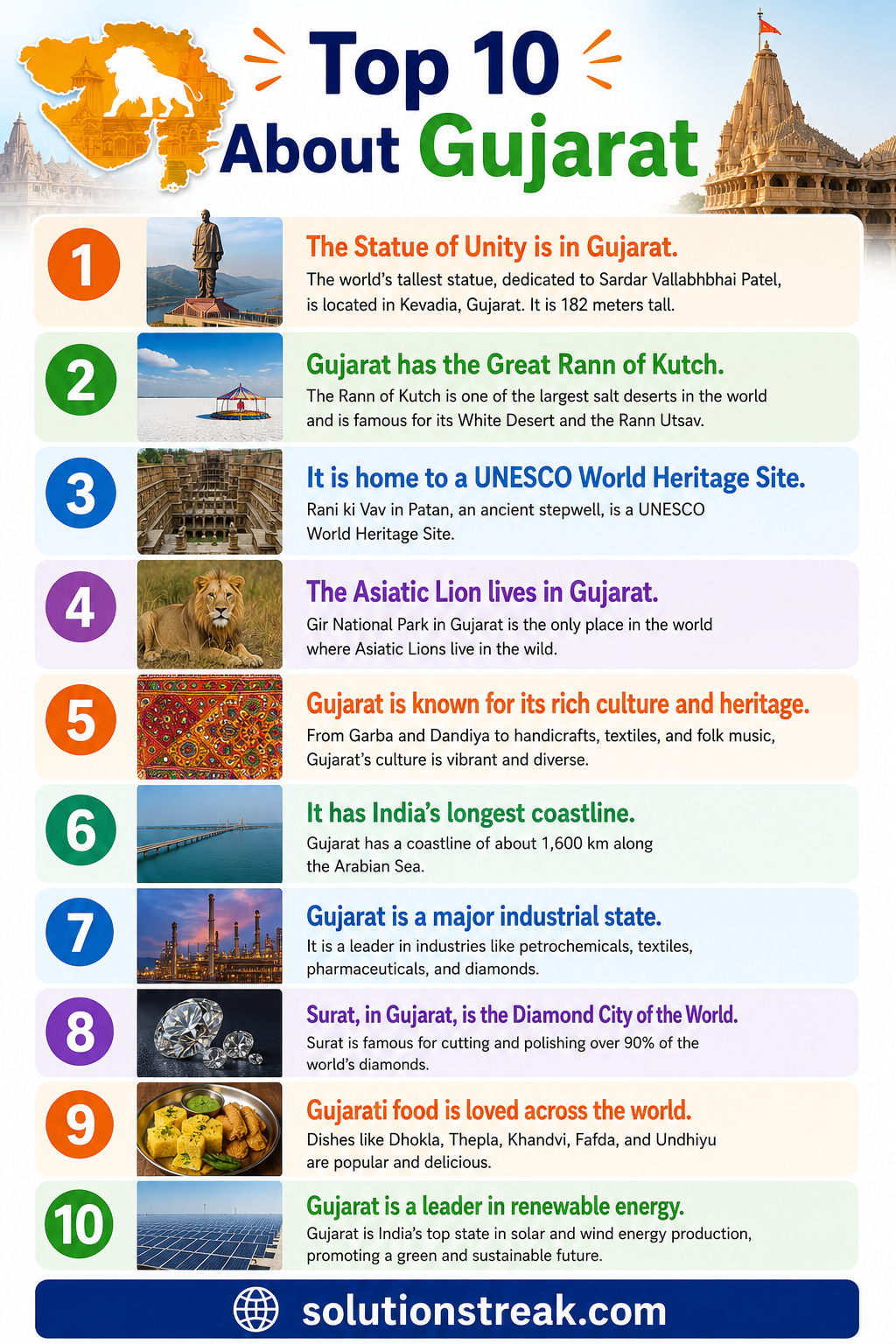
Top 10 Facts About Gujarat
Gujarat is a country where business, history religion, and culture coexist in a the most natural manner. It is among the states that stand out in India. It is recognized for its rich traditions as well as its sharp business sense as well as vibrant festivals and deeply spiritual roots. From ancient ports to contemporary industrialization, Gujarat has always been connected to the world but firmly to its own distinctive identity.
What is it that makes Gujarat distinctive isn’t one thing. It’s the blend of forests and deserts as well as temples and industries as well as folk music and modern cities. Gujarat has shaped the freedom movement, trade and its cultural values over many centuries. To truly comprehend Gujarat it is essential to go beyond stereotypes and look into the strengths that are not widely known.
10 Facts About Gujarat
1. Gujarat Has One of the Longest Coastlines in India
Gujarat boasts the largest coastline among Indian State, stretching for more than 1,600 km. This coastline has played a significant influence on the state’s economic and historical development.
For centuries, the ports of Gujarat linked India with Africa and Africa, Middle East, and Europe. The traders carried spices as well as textiles and valuable stones over the ocean. Today, Gujarat remains a major center for shipping, ports and maritime commerce and is a major gateway to India and the rest of the world.
2. The Asiatic Lion Lives Only in Gujarat
The Asiatic Lion, which once roamed throughout Asia It is now confined within India’s Gir Forest of Gujarat.
This means that Gujarat the sole protector of this species that is endangered. Constant conservation efforts by the state have contributed to the increase in the number of lions in the many years. Gir Forest is not just an animal sanctuary, it is also an example of harmonious coexistence between nature and humans.
3. Gujarat Is One of India’s Strongest Business States
Gujarat is a place with a long-standing tradition of entrepreneurship and trade. It isn’t only a job in Gujarat, it is an integral part of the tradition.
From small, family-run businesses to huge industrial buildings, Gujarat has produced some of the most successful business leaders. The focus of the state on infrastructure, the ease of investing and business has helped make it an important industrial powerhouse, especially in areas such as chemicals, textiles, the pharmaceutical industry as well as renewable energy.
4. The Rann of Kutch Is a Natural Wonder
The Great Rann of Kutch is one of the biggest salt-sand deserts on earth. In the dry season it becomes a vast, white expanse that extends as far as the eye can reach.
In the monsoon, areas of the Rann flood with water, transforming the area. In addition, the Rann is also the home of unique wildlife, and is the site of the famous Rann Utsav which celebrates Gujarat’s traditional culture, arts and crafts and music.
5. Gujarat Played a Major Role in India’s Freedom Struggle
Gujarat has a special position in the Indian independence movement. Its Sabarmati Ashram in Ahmedabad was the home of Mahatma Gandhi throughout his time.
From here, he started actions that altered the history in Indian history, such as the Dandi March. Gujarat was a hub for non-violent resistance and was the moral foundations of India’s liberation struggle.
6. Gujarati Cuisine Is More Diverse Than It Looks
Gujarati food is typically described as sweet and vegetarian however, that’s just part of the story.
The food options vary widely according to the region. In coastal areas, seafood is served and seafood, whereas Kathiawadi food is hot and rustic. Jain cuisine avoids root vegetables entirely. This variety of Gujarati cuisine reflects its geography, climate, as well as the cultural influence. Food here is closely tied to community and tradition.
7. Gujarat Is Home to Some of the Oldest Temples
Gujarat is a place of religious activity for a long time. Temples such as Somnath aren’t just locations of worship, they are also represent strength and faith.
Somnath Temple was repeatedly destroyed and rebuilt over the years, yet it has remained steadfast. Gujarat is also a major center for Jainism as well, with holy places like Palitana attracted by pilgrims from all over the globe.
8. The State Has a Rich Folk Art and Craft Tradition
Gujarat is known for its colorful folk art embroidery, mirror work and handicrafts. Every region is distinct in its distinct style color, technique, and style.
These arts and crafts aren’t just ornaments, but they tell stories of communities as well as beliefs and everyday life. Today, many artisans keep these traditions alive and pass on their techniques from generation to the next generation.
9. Gujarat Is a Leader in Renewable Energy
Gujarat is among the top states in India for renewable energy sources, including wind and solar power.
Large solar parks as well as wind farms have assisted the state in moving towards sustainable growth. This demonstrates how Gujarat integrates economic growth and the environment, and is preparing for the next generation while protecting the natural environment.
10. Gujarat Blends Modernity and Tradition Life
Despite its rapid growth in industry, Gujarat has maintained its traditions. Festivals such as Navratri celebrate with a dazzling enthusiasm, bringing whole communities together through music and dance.
While at the same time cities such as Ahmedabad, Surat, and Vadodara continue to expand as modern urban cities. Gujarat is proof that progress doesn’t mean sacrificing the past. Both can expand together.
Final Thought
Gujarat is more than an individual state, it is a mentality formed by grit, determination and a strong set of values. In the past, there were ancient harbors to modern-day industries and desert landscapes to holy forests Gujarat has many selves simultaneously.
To understand Gujarat is to know how business, culture as well as faith and nature can coexist in harmony. This balance is the reason that makes Gujarat an exceptional place to live.
You may also like



Leave a Reply