
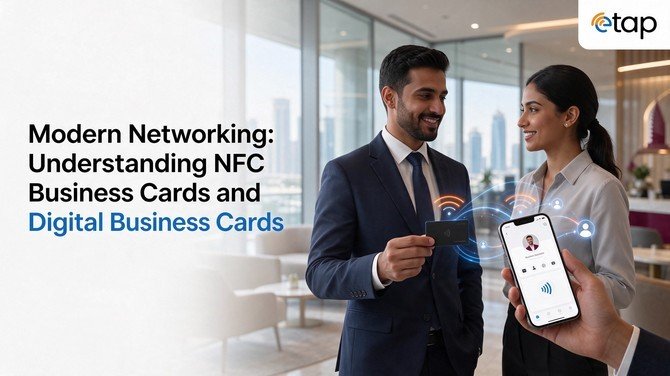
Modern Networking: Understanding NFC Business Cards and Digital Business Cards
Professional networking has become increasingly digital. People now connect through email, social media, messaging platforms and online meetings, but exchanging contact details in person remains an important part of business development.
Digital business cards and NFC business cards offer two ways to make that exchange more convenient. While the terms are sometimes used interchangeably, they describe slightly different things.
What Is a Digital Business Card?
A digital business card is an online professional profile containing information such as:
- Name and job title
- Company name
- Phone number and email address
- Website and social media links
- WhatsApp contact
- Portfolio or business information
- Location and appointment links
It can be shared through a direct URL, email, messaging app or QR code. Since the information is stored digitally, changes to contact details can generally be made without printing a new card.
What Is an NFC Business Card?
An NFC business card is a physical card containing a Near Field Communication chip. The chip is typically programmed with a link to the owner’s digital profile.
When someone brings a compatible smartphone close to the card, the phone can detect the NFC tag and open the linked profile.
The physical card provides the tap-to-share experience, while the digital profile displays the actual contact information.
Some NFC cards also include a QR code, giving recipients an alternative way to access the same profile.
Key Differences
| Feature | Digital Business Card | NFC Business Card |
| Physical card | Not necessary | Available |
| Digital profile | Yes | Yes |
| Sharing method | Link or QR code | NFC tap, link or QR |
| Face-to-face networking | Suitable | Particularly convenient |
| Custom physical branding | Limited | Available |
| Profile updates | Generally possible | Generally possible |
The main difference is the sharing method. A digital business card can exist entirely online, while an NFC business card combines a physical product with a digital profile.
Which Option Is Better?
The right choice depends on how a person works and networks.
A digital-only card may be suitable for remote professionals, freelancers and teams that primarily communicate online. It can be shared quickly through messaging apps and email.
An NFC card may be more useful for people who regularly attend exhibitions, conferences, meetings and networking events. It provides a physical item to present while allowing recipients to access a digital profile.
Some professionals may prefer to use both formats to cover online and in-person situations.
What Should You Consider Before Choosing?
Think about how frequently you share your contact details, whether physical branding matters, how often your information changes and which sharing methods your audience is comfortable using.
It is also useful to check whether the card supports QR access as an alternative to NFC tapping.
For a more detailed comparison of the two formats, read ETAP’s guide to NFC business cards versus digital business cards.
Final Thoughts
Digital and NFC business cards are not necessarily competing products. They can work together to make professional networking more flexible. Choosing the right format depends on individual preferences, business requirements and the situations in which contact details are most often exchanged.
You may also like

Leave a Reply